The Making
Gassner Built a Desert That Had to Look Unbuilt
Dennis Gassner's art department faced a paradox: the more carefully they constructed the Gulf War's infrastructure, the more thoroughly it had to disappear into the sand.
The Paradox of Built Abandonment
Production design on Jarhead was not, in the conventional sense, about beauty. Dennis Gassner — whose credits include the controlled opulence of The Truman Show and the claustrophobic period decay of Barton Fink — was asked by Sam Mendes to build something that actively resisted the eye: tent cities, forward operating areas, makeshift briefing rooms, oil-field infrastructure, all of it assembled on location in the Imperial Valley and in the desert outside Mexicali, and all of it required to look as though the art department had never shown up.
That is harder than it sounds. The temptation in production design is coherence — the instinct to make every element intentional, every surface readable. In Jarhead, coherence was the enemy. The Gulf War's actual forward areas were accretions of military-issue kit, sand drift, boredom and improvisation: tents staked into ground that shifted, equipment staged and restaged until it was half-buried, briefing rooms that were canvas walls held by a frame someone had sunk too shallow into loose soil. Gassner's department had to recreate that quality of provisional, collapsing order without ever letting the construction underneath show.
Tent Cities and the Grammar of Temporary
The battalion area sequences — the long stretches of Jarhead built around waiting, physical training, and the particular low-grade misery of desert encampment — demanded sets that could be filmed from multiple angles without revealing their edges. The art department's answer was to lay out structures in genuine depth, not as a stage flat, so that Roger Deakins's camera could move through them rather than past them. Scale was deliberate: the tent city needed to communicate institutional scale — the sense of a mobilisation too large for any individual to comprehend — while still resolving, at close range, into the intimate squalor of two or three men in a canvas space too small for their equipment.
Sand management was a constant practical concern. The Imperial Valley locations around Glamis and Brawley provided genuine desert terrain, but the grain and colour of California sand does not behave identically to Kuwaiti sand under different light conditions. Gassner's team worked with Roger Deakins to understand what the camera would read and what it would not — which meant that some surface-dressing decisions were driven by photographic outcome rather than strict archaeological fidelity to the 1990–91 theatre.
The Oil-Field Set Pieces
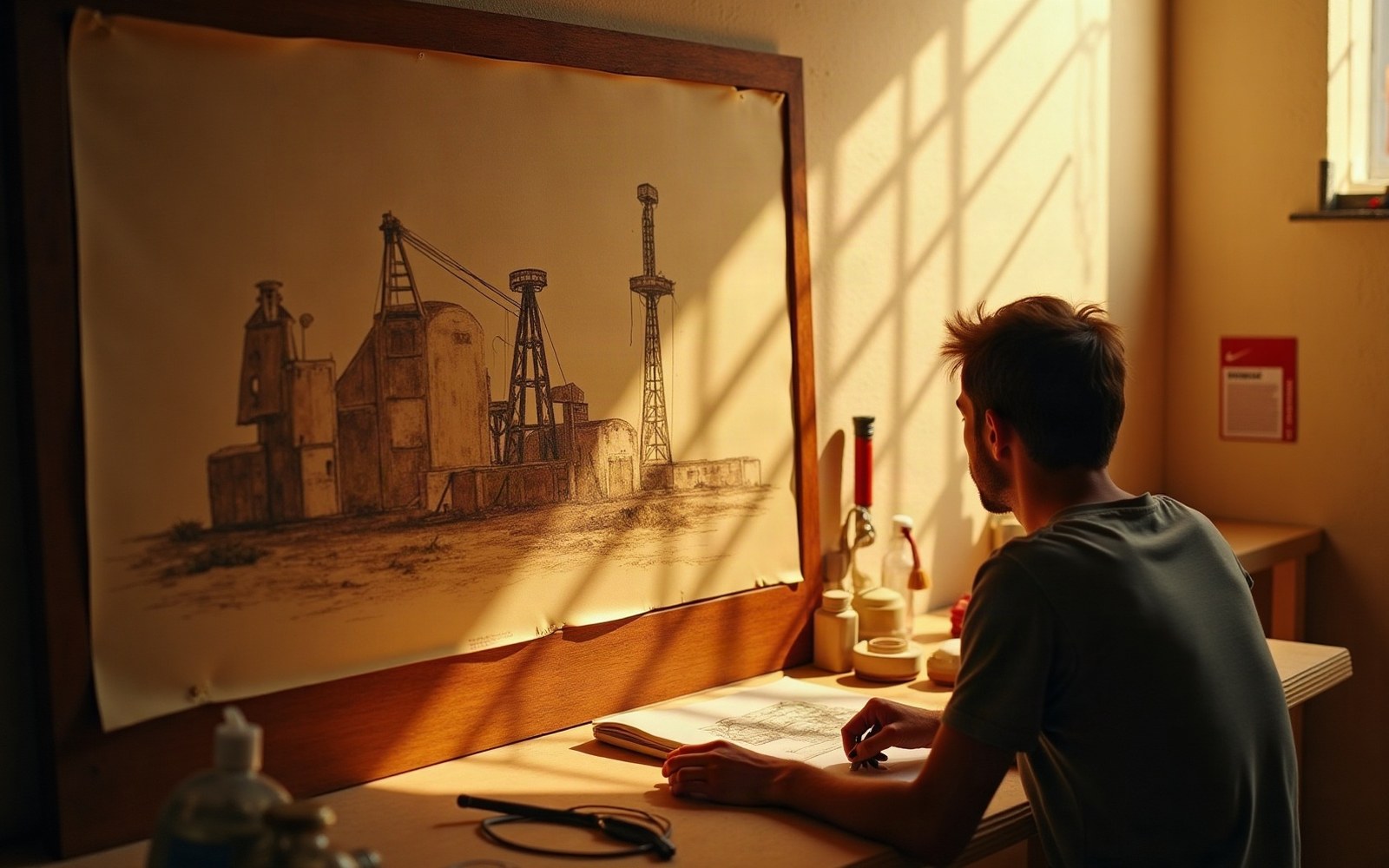
The burning-well sequences are where Gassner's problem became most acute, and most visible in the finished film. The Kuwaiti oil fires — the burning of approximately 600 wells by Iraqi forces in early 1991 — left a landscape of industrial wreckage set against sky turned the colour of a bruise. Recreating that environment meant sourcing, positioning and ageing oil-field hardware: wellhead components, pipe runs, rigging structures, derelict machinery. Every piece had to carry the right kind of deterioration — not the weathering of years of neglect, but the specific shock-damage of industrial sabotage and weeks of uncontrolled burning.
What Gassner's department could not fully build, the production photographed as plate material and supplemented with practical fire effects. The combination — real hardware dressed and aged by the art department, practical flames, and the extraordinary ambient light produced by Roger Deakins's exposure strategy — is what gives those sequences their quality of found catastrophe rather than designed spectacle. The set exists; it is also, clearly, on fire; and the design work succeeds precisely because neither condition calls attention to the craft behind it.
What Good Production Design Hides
The measure of Gassner's achievement on Jarhead is that none of this reads as designed. The tent stakes look as though they were hammered in by exhausted Marines at two in the morning. The briefing-room canvas sags in a way that suggests institutional indifference rather than a set dresser's calculation. The oil-field wreckage carries weight, mass, history. Good production design — the kind Gassner built his career on — hides inside its own results. On Jarhead, hiding was, from the first production meeting, the entire point.