Stills
The Burning Wells: Six Frames and What Deakins Did with Them
A frame-by-frame visual analysis of the oil-fire sequences — exposure held at the edge of blow-out, figures reduced to silhouette, and a landscape that has no horizon.
The Light That Cannot Be Corrected
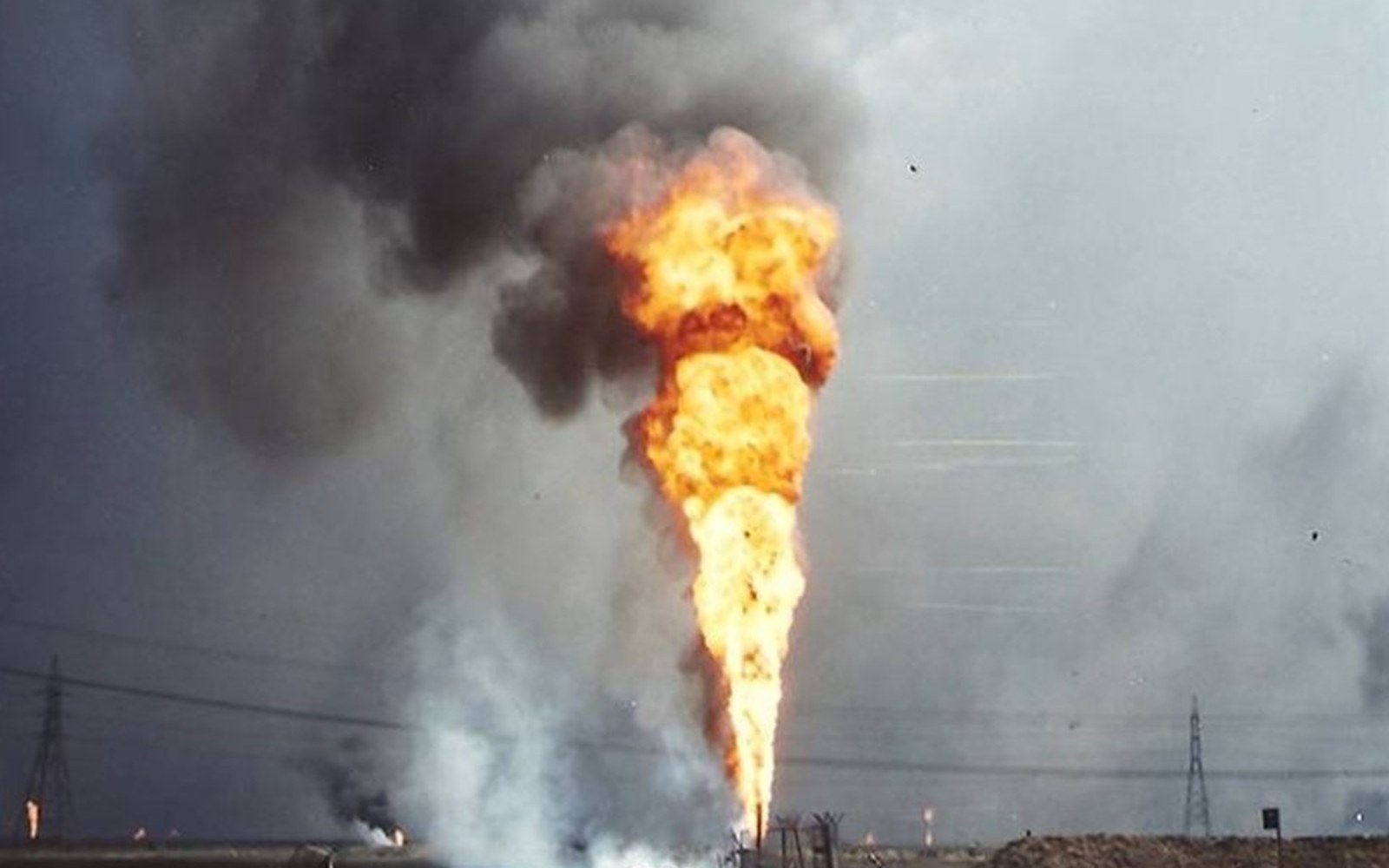
Roger Deakins shot Jarhead in Super 35 with spherical lenses, and nowhere does that choice pay larger dividends than in the burning-oil-field sequences. A column of fire floods the lens with light the way no studio fixture ever could. The flame produces its own glare naturally. In the six frames examined here, Deakins does not fight that effect; he structures the image around it.
The first frame to study is the wide establishing shot of Marines entering the field. Deakins exposes for the sky, which means the ground and every figure on it collapse into pure black. The well-heads are not visible as machinery — they read as darker verticals inside the orange-yellow glow, their geometry absorbed by the fire above them. The horizon line has been eliminated: the smoke canopy seals the top of the frame, and the burning ground seals the bottom, leaving a band of lit gas in the middle that has no spatial reference. The Marines walk into this band and become shapes, not men.
Silhouette as Moral Geometry
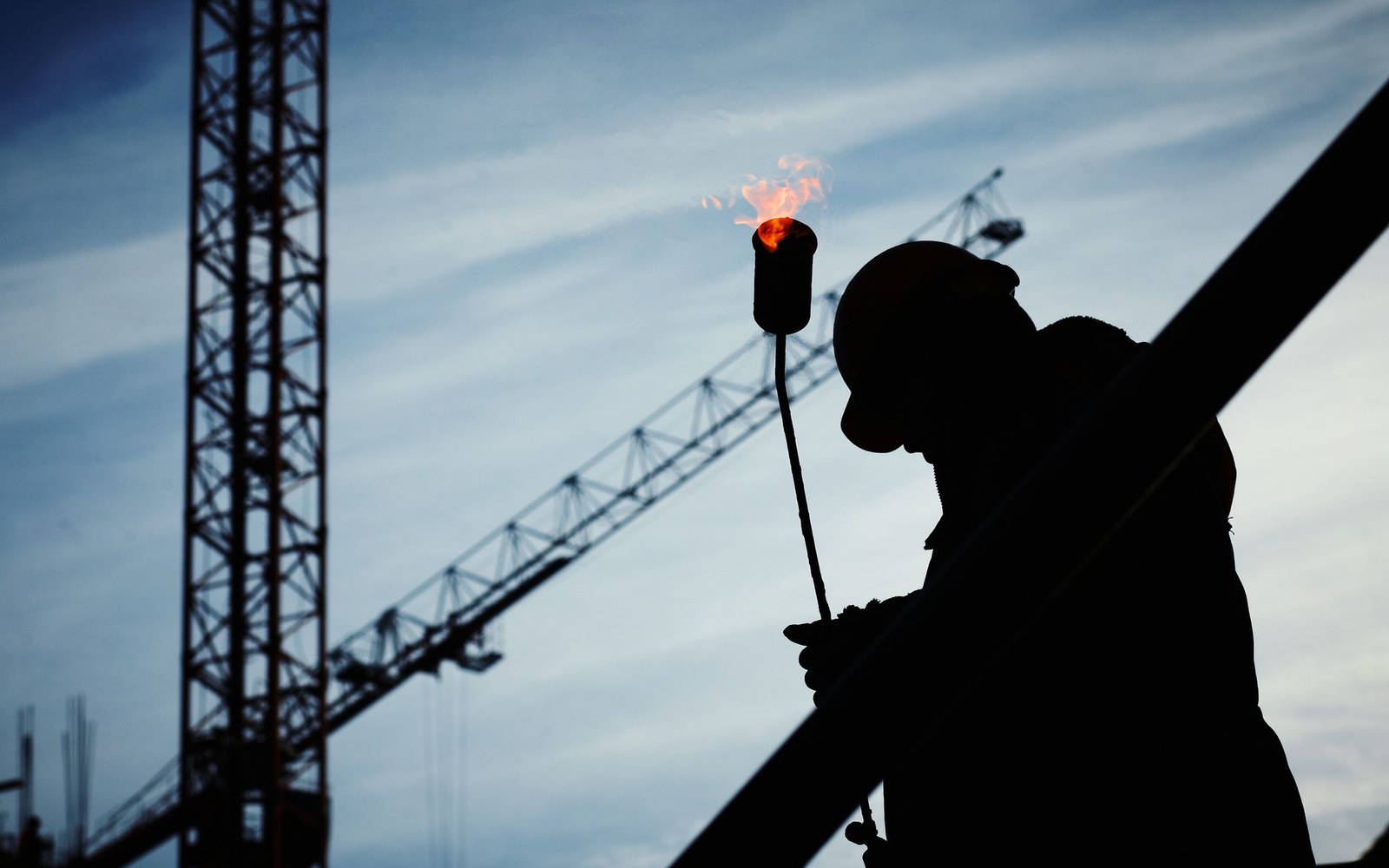
The second and third frames work as a pair. In both, a single figure — Swofford, identifiable by build and posture rather than any legible feature — stands at the edge of a gushing well. Deakins places him hard left in one frame, dead center in the next. The lesson is in what changes. Off-center, the figure is compositionally subordinate to the fire: the blaze occupies two-thirds of the width, and the man is a counterweight, present but not dominant. Centered, the geometry shifts entirely. The fire now brackets the figure, burning symmetrically on both sides, and the silhouette reads as monumental — a human form held inside something vast. Neither frame editorializes. Both observations are factual, structural.
The fourth frame tightens to a two-shot, Swofford and Troy, their shoulders nearly touching. According to cinematographer documentation held at the American Film Institute, Deakins has spoken across multiple productions about the relationship between proximity and scale, and here the principle is visible: two silhouettes together produce a shared mass that registers differently than either alone. The fire column behind them is slightly out of focus — Deakins has racked forward to favor the figures — so the flame loses its texture and becomes a wall of pure luminance. The men, by contrast, are sharp-edged. The contrast between their crisp outlines and the boiling background is how the frame insists on their presence without showing their faces.
Exposure at the Edge
The fifth frame is the most technically demanding of the sequence. A well-documented aspect of Deakins's practice is his reluctance to rely on post-production grading to achieve effects that can be achieved in camera, and this frame demonstrates the discipline. The fire occupies the upper right quadrant and is allowed to blow out — the highlights clip, the flame loses internal detail, the white core is pure overexposure. This is a decision, not a failure. The blown highlight functions as a void, an absence of information that the eye reads as heat too intense to resolve. The figures in the lower left are exposed at roughly two stops under the mid-tone, so they register as dense, lightless shapes against the scorched ground.
The sixth and final frame pulls back to an aerial-adjacent angle — not a true aerial, but a high crane position that flattens the field into a near-abstract arrangement of fire columns and moving dots. Here the wide frame earns its keep in a different register: the high angle flattens the field, the columns arrayed across the frame like an architectural row. The soldiers are the dots. The scale relationship between the burning infrastructure and the human figures is, at this distance, approximately what the Kuwaiti oil fires actually produced: an industrial catastrophe beside which individual bodies are geometrically negligible. Deakins doesn't add that observation. He simply doesn't remove it.