The Field
Three Kings Was the Argument Jarhead Answered
David O.
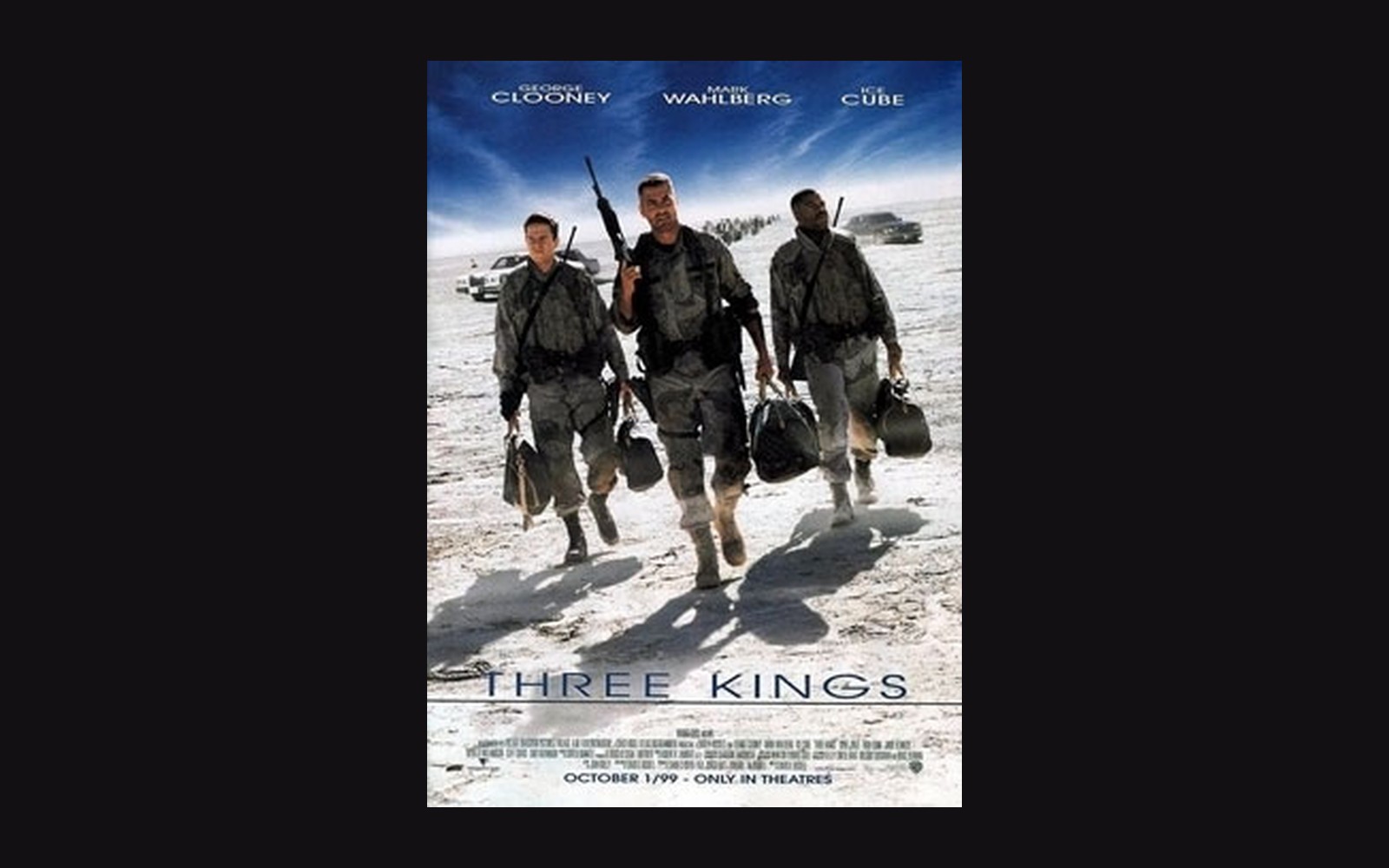
Two films, one war, opposite registers
Three Kings arrived in 1999 — the same year Sam Mendes released American Beauty — and immediately established itself as the defining cinematic statement on the 1991 Gulf War. David O. Russell's film was chaotic, satirical, morally sharp, and furious: a heist picture that collapsed into a humanitarian crisis and indicted American foreign policy in the same breath. When Universal Pictures released Jarhead six years later, critical conversation reflexively reached for Three Kings as the measuring stick. The comparison was reasonable and also, ultimately, misleading.
Both films share a geography — desert, oil, sand the colour of old bone — and a historical moment, the brief land war that ended before it seemed to have properly started. Both are interested in men who trained for combat they never received. But the tonal gulf between them is almost total. Three Kings is kinetic and argumentative; it has an enemy, a moral position, a satirical engine running at full heat. Jarhead is inert by design. Its thesis is boredom made physical, and its antagonist — if it has one — is the absence of anything to shoot at.

The enemy problem
The central formal challenge both films face is the same: the Gulf War produced no prolonged ground engagement, no jungle, no hill to take and retake. It ended in a hundred hours of combat and left its participants stranded in a landscape without a clear narrative shape. Russell solved this by inventing one — giving his soldiers a mission, a cache of Kuwaiti gold, and, eventually, Iraqi civilians whose suffering forces an ethical reckoning. The film's politics are explicit. The American failure to support the Shia uprising after the ceasefire is dramatised in real time, and the soldiers are implicated in it.
Mendes and screenwriter William Broyles Jr declined that move entirely. Anthony Swofford's source memoir offered its own bitter analysis of American foreign policy, but the film strips most of it back, leaving something closer to phenomenology: what it felt like to be there, waiting, hot, purposeless. The enemy in Jarhead barely appears. Iraqi soldiers are glimpsed at a distance, surrendering, already defeated. The war ends before Swofford fires a single round in combat, and the film treats this not as irony to be pressed but as the defining fact of the experience.
Shared ground, different conclusions
Roger Deakins shot the Kuwaiti oil fires against a sky that needed no manipulation — the smoke columns and burning wells provided an apocalypse the production had simply to frame. Russell, working with cinematographer Newton Thomas Sigel, used a different kind of visual aggression: desaturated stock, crash-zooms, handheld urgency. The aesthetic difference is the argument made visual. Three Kings treats the Gulf War as a failure of policy legible in action. Jarhead treats it as a failure of experience legible only in stillness.
Critics who found Jarhead elusive in 2005 were often measuring it against the template Three Kings had set — expecting satire, finding something closer to Thomas Newman's suspended silences. But the films are not actually competing for the same territory. Russell was making a film about what America did in 1991. Mendes was making a film about what 1991 did to the men sent there, and specifically what it failed to do to them. The pool-feed imagery and green night-vision footage that shaped civilian understanding of the war barely touched the ground truth Swofford was describing.
Measured against each other, the two films outline the full shape of a conflict that resisted single interpretation. Three Kings insisted the war meant something and that its meaning was damning. Jarhead insisted the war meant nothing — and found in that nothing a different, quieter kind of damage. Neither position cancels the other. Together, they constitute the genre's most sustained argument with itself.