The Field
The War That Played Live, and What That Did to Every Film That Followed
The 1991 Gulf War was the first conflict watched in real time by a global audience — and that singular fact made every subsequent Gulf War film a reckoning with footage that already existed.
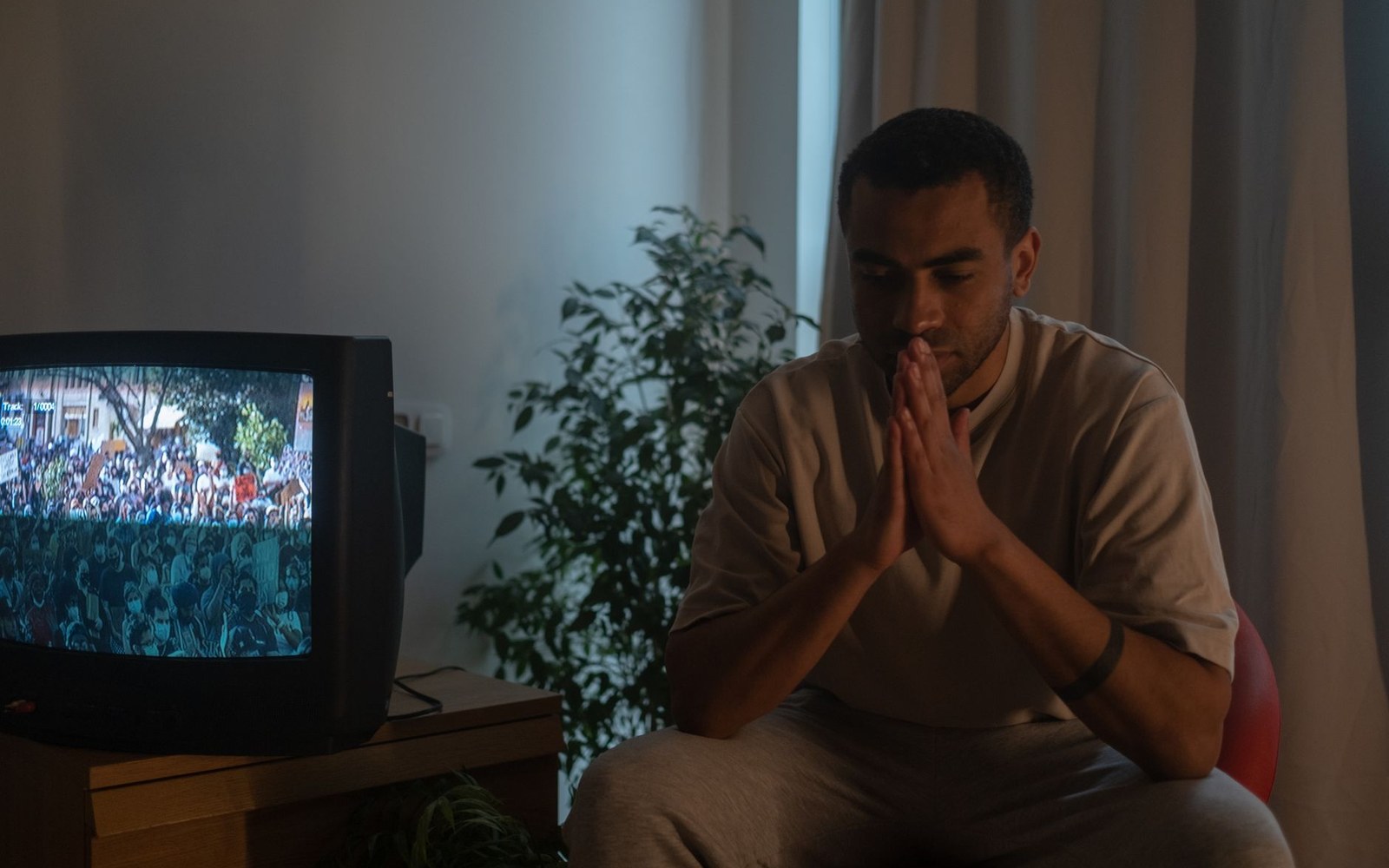
A War in Three Colours: Green, White, and Black Smoke
No conflict before it arrived pre-imaged. Vietnam had its photographers — Nick Ut, Eddie Adams — but their work reached audiences days later, through print, processed through the metabolism of newspaper culture. The 1991 Gulf War reached living rooms the same night it began. CNN broadcast the coalition's first air strikes over Baghdad on 17 January 1991 while the anti-aircraft fire was still climbing. The network's correspondents spoke from their hotel window into an open phone line as the city lit below them. It was not reporting that processed an event; it was the event itself, in transmission.
The footage that followed came in two dominant visual registers. The first was the pool-feed imagery distributed through official military channels — carefully controlled, released on embargo, shaped to show precision and restraint. The second was the accidental aesthetic of the night-vision camera: phosphorescent green, high-grain, depth-flattened, everything rendered in the same spectral wash that made a falling bomb and a city street look like the same species of unreality. Together these two registers constituted a visual vocabulary so widely circulated that by the time the war ended, its imagery had already become the standard expectation — not just for news coverage, but for what a Gulf War was supposed to look like. Any film made about that conflict would have to position itself against pictures the audience had already seen.
That inheritance created a problem filmmakers did not face with earlier wars. A Vietnam film could construct its own visual logic because no one at home had watched the war's daily footage in real time. The Gulf War arrived pre-aestheticised, filtered through the specific limitations of broadcast technology — the washed-out palette, the sanitised geometry of cockpit cameras, the smooth studio authority of anchors who were never within two thousand miles of Kuwait. To make a Gulf War feature was, necessarily, to respond to that pre-existing image bank.
What Three Kings Did, and What It Refused
David O. Russell's Three Kings (1999) was the first major studio picture to treat that inheritance as an explicit subject. The film did not merely depict the Gulf War; it examined the gap between the televised version and the one happening out of frame. Its distinctive visual strategy — bleach-bypass processing, colour shifts mid-scene, instantaneous anatomical cutaways — was a direct argument against the clean certainty of pool-feed imagery. Where official footage smoothed and abstracted, Russell's cinematography with Newton Thomas Sigel was aggressively tactile: sweat, blood, the precise mechanics of a bullet's path through tissue. The film refused the war's television skin.
Edward Zwick's Courage Under Fire (1996) had arrived three years earlier and taken the opposite approach. Working before the conflict had been fully absorbed into cultural memory, Zwick used the Gulf War largely as a moral arena — a space to run an investigation narrative about testimony, truth and gender in the military. The television footage hovers at the edges of that film without becoming its subject. The picture's visual grammar is classical and composed; it owes more to the courtroom procedural than to the CNN broadcast. That relative insulation from the broadcast inheritance is precisely why the film reads differently from everything that came after, and why it registers now as a pre-discourse document — made before the pool-feed aesthetic had fully calcified into genre expectation.
By the time Sam Mendes made Jarhead in 2005, the broadcast imagery had migrated into the film's diegesis itself. The characters watch it. In one of the film's most formally coherent sequences, Swofford's unit gathers to watch Apocalypse Now — Francis Ford Coppola's 1979 film, which had by then become the template through which young American soldiers processed the idea of war — and respond to it as entertainment, as myth, as a machine for excitement that has nothing to do with what they are actually experiencing in the Saudi desert. The television set is a recurring prop throughout Jarhead: it shows the men their own war, the public version, the one mediated and packaged and offered back to them as information. The gap between that image and their boredom, their inaction, their unreleased professional ambition is the film's central subject.
The Aesthetic the Films Inherited and the One They Made
Roger Deakins shot Jarhead on anamorphic lenses, letting the high-noon desert sun burn into the image without correction. The choice placed the film in explicit opposition to the green-lit flatness of night-vision footage: the palette is bleached, overexposed, visually exhausting in the way that actual desert service is thermally exhausting. Where broadcast coverage made the war legible — sharp borders, stable horizon lines, the reliable framing of a camera set on a hotel balcony — Deakins made it oppressive and ambient. The frame does not give the viewer comfortable orientation. It asks for endurance rather than surveillance.
That strategy would be extended, differently, by Kathryn Bigelow in The Hurt Locker (2008), where the shift in conflict geography — from the Saudi desert and Kuwait to Iraq's urban and peri-urban environments — allowed a more fragmented, handheld visual register without the burden of the Gulf War's specific television legacy. Bigelow's film largely escapes the pool-feed inheritance because the Iraq War's media coverage was itself more chaotic, more pluralist, shot on more kinds of equipment by more kinds of journalists. The embed journalism model that produced Evan Wright's reporting and subsequently Generation Kill distributed the visual field; no single network or pool system owned the war's image in the way CNN effectively owned 1991.
The 1991 conflict's legacy is therefore most concentrated in the films made between 1996 and 2005 — the decade in which the broadcast vocabulary was both fresh enough to haunt filmmakers and distant enough to permit artistic response. Courage Under Fire, Three Kings, and Jarhead form a loose trilogy not of shared subject matter but of shared anxiety: each is arguing, in its own formal language, with images the audience brought into the theatre before the lights went down. The television footage created a prior text. Every film was adaptation, whether it acknowledged this or not.
The green glow of the night-vision camera did something specific and lasting: it made the Gulf War legible as a technological spectacle while rendering it morally opaque. The precision it seemed to show — a guided missile finding its target, the crosshairs steady — concealed the human scale entirely. What moved beneath those crosshairs was resolved into geometry, not consequence. The films that followed the broadcast have, each in their own way, been trying to restore that resolution ever since — to put people back into the frame that military media management and the specific limitations of broadcast technology conspired, between them, to empty out.